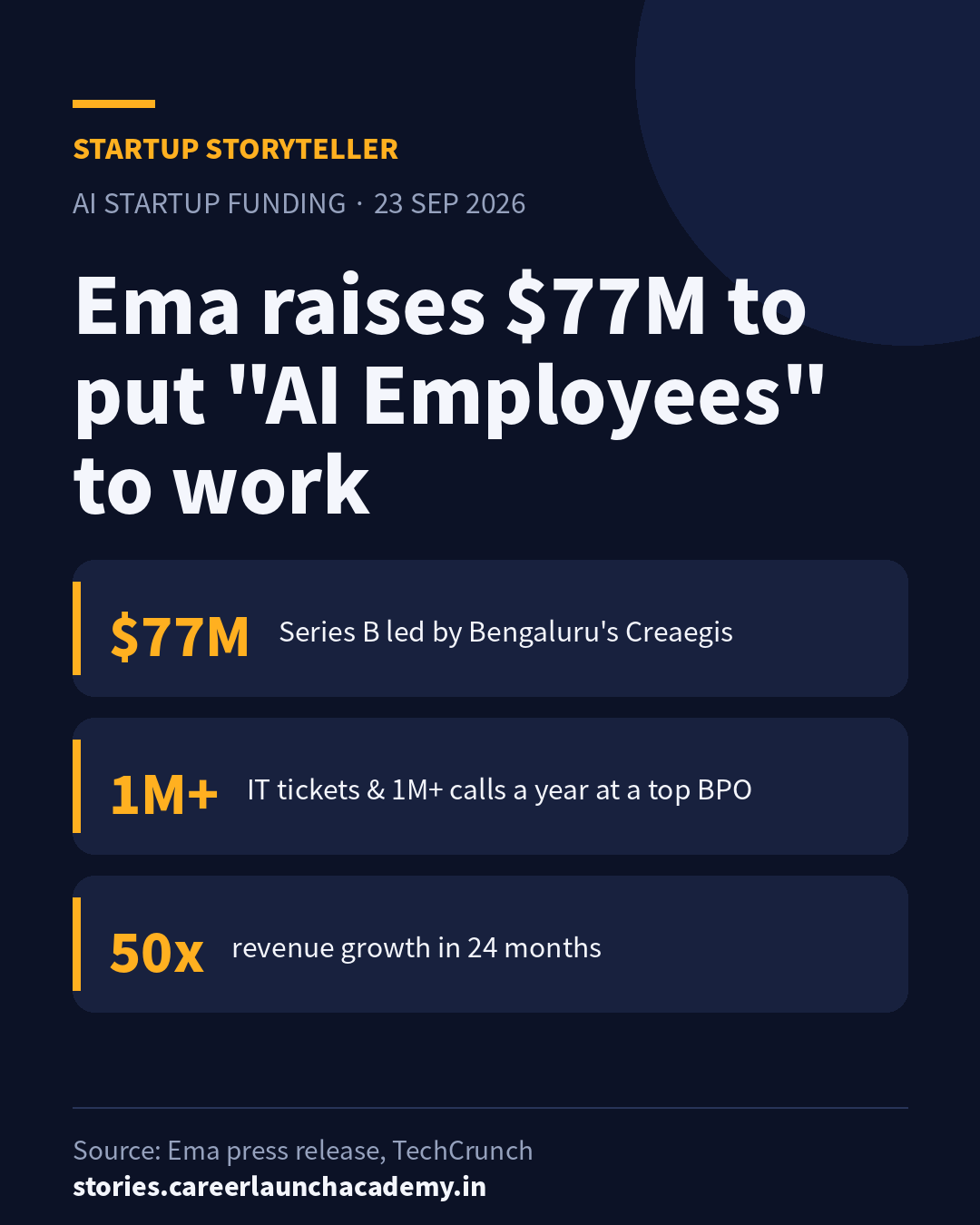
On 23 September 2026, Ema, the enterprise AI company co-founded by Surojit Chatterjee, announced a $77 million Series B round. The round was led by Creaegis, a Bengaluru-based venture firm, with existing investors Accel, S32 and Prosus all increasing their stakes. Ema has now raised $140 million in total, and says the round more than quadruples its valuation from its previous raise.
The headline number is big. The idea behind it is bigger.
The story: software that does the work, not just holds it
Most enterprise software is a place where work is recorded — tickets, forms, payroll entries. A human still does the work. Ema is betting that this is about to flip.
The company builds what it calls agentic “AI Employees” that handle routine operations across HR, IT and finance: answering employee queries, resolving IT service tickets, handling calls. Named customers include Wipro, Hitachi, ADP and PwC.
The deployment numbers Ema shared show the scale:
- At one top-5 global systems integrator, Ema supports 240,000 associates across 65 countries, handling 2.9 million employee queries a year, with 60% ticket avoidance.
- At one top-5 BPO, its AI Employees handle 1+ million IT service tickets and 1+ million calls a year in 15+ languages.
- The company reports 50x revenue growth over 24 months.
Chatterjee summed up the pitch in one line: “Enterprises do not need more software. They need work to get done.”
Why this matters for India
There is a strong India thread in this story. The round’s lead investor, Creaegis, is based in Bengaluru, and Ema has an office in the city. More importantly, several of its largest deployments are at IT services and BPO companies — the industries that employ millions of Indian graduates.
When a top BPO uses AI to handle a million calls a year, that is not a lab experiment. It is a signal about how entry-level operations work is going to change.
What it means for your career
This isn’t a reason to panic. It is a reason to reposition. Three takeaways for students and early professionals:
- Routine ticket-and-query work is being automated first. Roles built only on repetitive L1 support are the most exposed.
- New roles are growing around the AI. Someone has to design workflows, integrate systems, check quality, and handle the escalations the AI can’t — Ema itself reports a sub-10% escalation rate at one BPO, and those escalations still need skilled people.
- Domain knowledge + AI skills is the winning combination. An HR, IT or finance professional who understands how to deploy and supervise AI agents is far more valuable than one who competes with them.
The bigger picture
Ema’s raise is part of a wider shift: investors are funding AI that replaces work, not just AI that assists with it. For founders, it’s a reminder that the biggest opportunities are in boring, high-volume business processes. For job seekers, it’s a clear sign of where to build skills next.
Sources