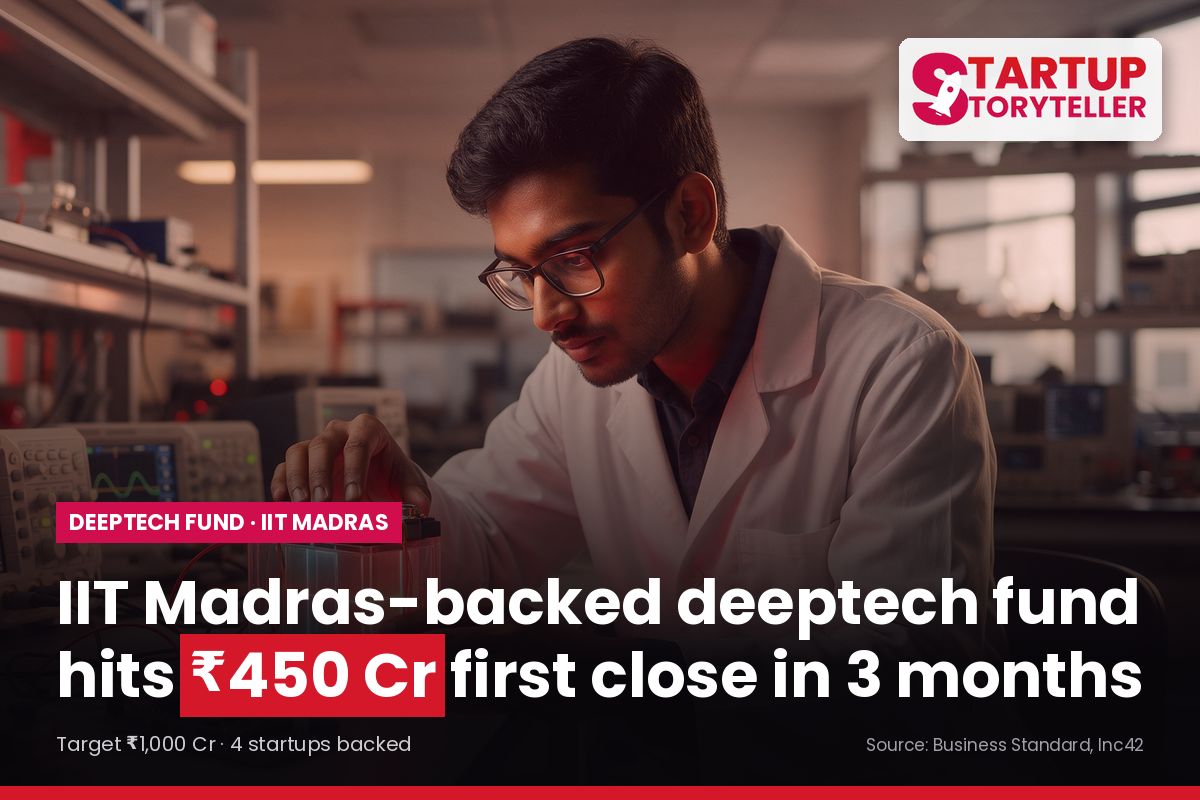
IITM Unicorn Frontier Fund I, run by IIT Madras, IIT Madras Research Park and Unicorn India Ventures, has hit a ₹450 crore first close and already backed four startups building rocket engines, quantum detectors, battery cells and carbon-capture systems.
Most IIT stories end with a placement. This one starts with a cheque.
On 26 September 2026, at Sangam 2026, the IIT Madras Alumni Association’s event in Bengaluru, IIT Madras and its partners announced the first close of their deeptech venture fund. The fund reached ₹450 crore three months after SEBI approval, and it has already deployed nearly ₹55 crore across four startups.
The deal
- Fund: IITM Unicorn Frontier Fund I, a SEBI Category II Alternative Investment Fund
- Partners: IIT Madras, IIT Madras Research Park and Unicorn India Ventures, which manages the fund
- First close: ₹450 crore, raised largely from IIT Madras alumni and family offices
- Target corpus: ₹1,000 crore (a ₹600 crore base plus a ₹400 crore greenshoe option), with the final close planned for December 2026. Institutions, corporates and banks are expected to join by then.
- Plan: about 25 IP-led startups, with cheques of ₹15–25 crore each
- Already deployed: nearly ₹55 crore across four companies
The four first investments:
- Hathor (Chennai): semi-cryogenic and cryogenic rocket engines for satellite launch vehicles
- Quanstra (Delhi): single-photon detection systems and quantum instrumentation
- Triolt Energy: high-performance lithium-ion cells for drones and fast-charging electric mobility
- Carbelim: bio-integrated carbon capture using microalgae
Explainer: what “TRL 3–4” and “patient capital” mean
The fund says most of its investments will be in companies at Technology Readiness Levels (TRL) 3–4. TRL is a 1-to-9 scale, first developed by NASA, that funders such as India’s Technology Development Board use to track how mature a technology is:
- TRL 1–2: a scientific idea on paper
- TRL 3–4: the idea works in a lab. There’s a proof of concept, but no product yet.
- TRL 6: a prototype works in a realistic environment
- TRL 9: the system is proven in real operations
TRL 3–4 is where many good research ideas die. They’re too far along for a research grant and too early for most venture capital funds, which usually want revenue. That gap is often called the “valley of death”.
Patient capital is money that doesn’t expect a quick return. A food-delivery app can show growth in months, but a rocket engine or a quantum detector can take years to reach customers. A fund built for deeptech has to be willing to wait.
The team
The fund is managed by Unicorn India Ventures, a venture capital firm co-founded in 2016 by Anil Joshi and Bhaskar Majumdar, who are both Managing Partners.
On the IIT Madras side, the fund is anchored by the institute and by IIT Madras Research Park, whose Group CEO is Natarajan Malupillai. The research park is one of India’s best-known university incubation ecosystems.
Why it matters
IIT Madras Director Prof. V. Kamakoti said the partnership would give these startups “patient capital and strategic growth guidance.”
Bhaskar Majumdar framed the moment as a turning point, saying India is entering a defining period for deeptech startups as the ecosystem moves from promise towards scale. Natarajan Malupillai made a similar point: India has the talent, but founders need appropriately sized, patient capital as they grow.
The fund’s focus areas are defence technology (with an emphasis on import substitution), space, semiconductors, manufacturing and robotics, AI infrastructure, and health technology. These overlap with the sectors the government is backing through programmes like the IndiaAI Mission, the India Semiconductor Mission and the ₹1 lakh crore RDI Fund.
Speaking at the same event, Union Finance Minister Nirmala Sitharaman said AI, semiconductors and quantum technology would drive India’s next big wave of infrastructure investment. “Investment in AI is definitely the next frontier,” she said.
What it means for your career
- Deeptech startups are hiring for hard skills. Rocket propulsion, battery chemistry, photonics and quantum instrumentation, and bio-engineering for carbon capture are now startup jobs in India, not only PSU or research-lab jobs. Core engineering branches (mechanical, chemical, electrical, physics) are back in demand.
- Your research project could become a company. This fund is built for TRL 3–4 ideas: things that work in a lab but aren’t products yet. If you’re doing a final-year project, a master’s thesis or a PhD, take IP, patents and incubators seriously. IIT Madras’s model shows how a lab idea can become a funded startup.
- Learn how deeptech money works. If you want to start a company, understand that deeptech runs on patient capital, milestones and TRL levels rather than monthly user growth. Founders who can explain their technology in those terms raise money more easily.
The bigger picture
India’s startup story has mostly been about apps: commerce, payments and delivery. Institutions like IIT Madras now want the next chapter to be about hardware and science.
A university-anchored fund is one piece of that puzzle. Government capital from schemes like the RDI Fund helps startups cross the prototype-to-product gap, and private venture funds help them scale. If IITM Unicorn Frontier Fund I reaches its ₹1,000 crore target and backs about 25 companies, expect other IITs and research institutions to try the same model.
Sources
- IIT Madras, Unicorn India mark ₹450 cr first close of ₹1,000 cr fund — Business Standard
- IIT Madras, Unicorn India Ventures Mark First Close Of Fund I At ₹450 Cr — Inc42
- IITM Unicorn Frontier Fund I hits Rs 450 Cr first close — YourStory
- IIT Madras-led deep-tech fund achieves Rs 450 Cr first close — DT Next
- IIT Madras Deeptech Fund Hits ₹450 Crore First Close — CIOL
- IITM Unicorn Frontier Fund — official website
- Unicorn India Ventures — team
- AI, semiconductors, quantum to drive India’s next infrastructure push: FM Sitharaman — ANI