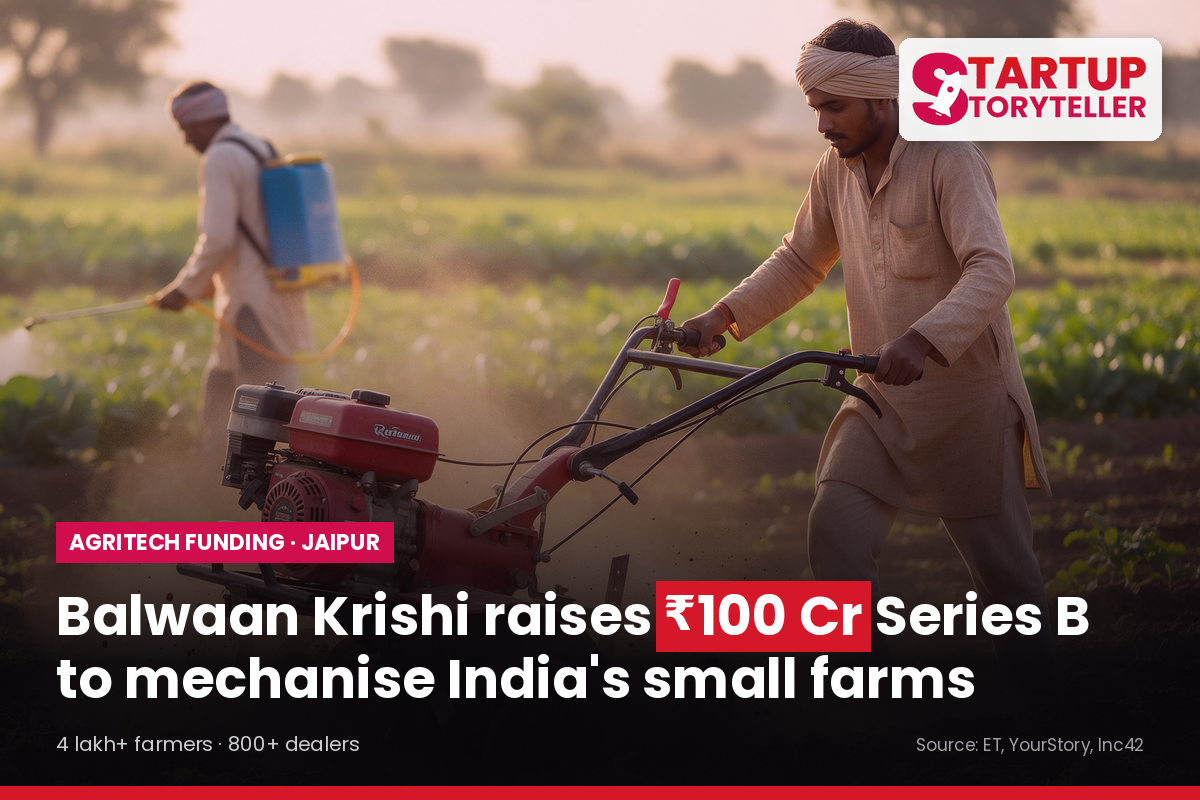
Jaipur-based Balwaan Krishi has raised ₹100 crore in a Series B round led by First Bridge India Growth Fund Private Equity. It plans to make more of its machines in India, expand into South India and build IoT-enabled farm equipment for small farmers.
Tractors get the headlines in Indian farming. Most Indian farms are too small for one.
That gap is where Rohit and Shubham Bajaj built their business. Their company, Balwaan Krishi, makes power weeders, battery sprayers and other farm machines sized, and priced, for small and marginal farmers. More than 4 lakh farmers already use them. On 28 September 2026, the brothers announced their biggest funding round yet.
The deal
- Amount: ₹100 crore (about $10 million, per Inc42)
- Round: Series B
- Lead investor: First Bridge India Growth Fund Private Equity
- Adviser on the deal: Right Pillar Advisors
- Where the money goes: more domestic manufacturing capacity, a stronger dealer and after-sales service network in South India, and new equipment with IoT and predictive-maintenance features
This is the company’s second institutional round in just over two years. In June 2024, JM Financial Private Equity invested ₹40 crore in Modish Tractoraurkisan Pvt Ltd, the company behind the Balwaan brand. Before that, it raised a $2 million pre-Series A led by the Caspian Leap for Agriculture Fund.
Explainer: why small farms need small machines
India’s farms have been shrinking for decades as land is divided between generations. About 86% of Indian farmers are small and marginal, cultivating less than two hectares, according to figures cited by the company.
That creates three problems:
- A full-size tractor rarely makes financial sense on a plot that small, and renting one isn’t always possible at the right time.
- Labour is getting costlier and harder to find, especially at peak weeding and spraying seasons.
- Imported or large-format equipment is often built for bigger, flatter farms.
Balwaan’s answer is a range of compact machines priced between ₹10,000 and ₹1 lakh. A power weeder or battery sprayer can replace hours of manual work, and a farmer can buy one outright.
The company sells through a hybrid model: more than 800 dealers across North India and e-commerce platforms. Dealers matter in rural India because farmers want to see a machine, get it serviced nearby and ask someone they trust. That’s why the new money is going into dealers and service in the South, not only into new products.
The IoT plan is worth watching. Predictive maintenance means sensors on a machine that flag problems before it breaks down. For a farmer, a breakdown in the middle of the season can cost a crop.
The team
Balwaan Krishi was founded by brothers Rohit Bajaj (Co-founder & CEO) and Shubham Bajaj (Co-founder & Chief Business Officer). Most reports say the company was founded in 2016, while JM Financial’s 2024 release says 2015.
In a 2024 interview with YourStory, the brothers traced the idea to a tractor launch event, where they saw an opening for budget-friendly equipment built for small and medium landholdings. Its leadership team now includes Jatin Basantani (Director of Operations), Umang Poddar (VP Exports) and Darshan Singh (CMO).
Why it matters
Rohit Bajaj framed the problem clearly: “India’s small and marginal farmers are increasingly facing rising labour costs and pressure to improve productivity, yet access to affordable mechanisation remains limited.” He added that more than four lakh farmers already using Balwaan machines gives the company “strong validation.”
Vishal Gupta, Managing Partner at First Bridge Investment Managers, said: “Balwaan operates at the intersection of a large addressable market, rising farm mechanisation adoption and proven customer demand.”
There’s also a manufacturing angle. The company plans to strengthen domestic manufacturing. Inc42 reports this is meant to reduce its reliance on imported machinery and components, which fits India’s wider push for home-grown manufacturing.
What it means for your career
- Hardware for Bharat is a real career path. Farm machinery companies need mechanical engineers, product designers and quality and manufacturing specialists. If you enjoy building physical products, look beyond automobiles and consumer electronics.
- IoT and data skills are moving into the field. Predictive maintenance needs embedded systems, sensors, connectivity and data analysis. Knowing how to make a ₹50,000 machine “smart” without making it unaffordable is a valuable and rare skill.
- Rural go-to-market is a skill of its own. Managing 800+ dealers, after-sales service and farmer trust is a different job from selling apps in metros. Sales, operations and business roles in Bharat-first companies can teach you how most of India actually buys.
The bigger picture
Indian agritech funding has often gone to apps: marketplaces, advisory and fintech for farmers. Balwaan’s round is a reminder that some of the biggest problems are physical. Someone still has to build the machine, get it to a village dealer and fix it when it breaks.
If Balwaan can make its machines in India, win over farmers in the South and add useful smart features without raising prices too much, it could show a path for other hardware startups that build for rural India rather than for city consumers.
Sources
- Balwaan Krishi raises Rs 100 crore in Series B to accelerate affordable farm mechanisation — The Economic Times (via inkl)
- Agricultural machinery company Balwaan Krishi raises Rs 100 Cr in Series B — YourStory
- Balwaan Krishi Bags ₹100 Cr To Scale Farm Equipment Manufacturing — Inc42
- Agricultural machinery company Balwaan Krishi raises Rs 100 Cr in Series B round — Entrackr
- Balwaan Krishi Raises ₹100 Cr In Series B To Expand Farm Mechanisation — Outlook Business
- Balwaan Krishi Raises INR 100 Cr in Series B Funding — Entrepreneur India
- JM Financial Private Equity invests INR 400 mn in Modish Tractoraurkisan Pvt. Ltd. (Balwaan) — JM Financial (official release, June 2024)
- Balwaan Krishi banks on accessibility and services — YourStory (Aug 2024)